Wednesday, July 4, 2012

Tip: Text to speech on smartphones

Here's how to use text-to-speech functionality on today's smartphones.…

Question. I’m partially blind. I’m about to buy a smartphone, but I don’t know whether there are any apps that will help me. What are my text-to-speech options on a smartphone?

image

Tech Tips

By Kim Komando

  • You can use Siri to speak text directly to your smartphone.Oli Scarff, Getty ImagesYou can use Siri to speak text directly to your smartphone.

Oli Scarff, Getty ImagesYou can use Siri to speak text directly to your smartphone.

Answer. Both Android and iOS have built-in text-to-speech menus and other features. Android’s menus come in the form of an app called Talkback. You can download it by going to Settings»Accessibility on your Android Phone. Apple’s mobile devices have an equivalent of the Voiceover feature you may recognize if you use a Mac. You can turn it on by going to Settings»Accessibility. If you haven’t decided which phone to buy, I would recommend picking up an iPhone. Not only does it have a much friendlier user interface, it has more apps made for people with vision problems than Android.

via http://www.speechtechnologygroup.com/speech-blog - Here's how to use text-to-speech functionality on today's smartphones.… Question. I’m partially blind. I’m about to buy a smartphone, but I don’t know whether there are any apps that will help me. What are my text-to-speech options on a smartphone? Tech Tips By Kim Komando Oli Scarff, Getty ImagesYo ...

Tuesday, July 3, 2012

Should You Consider Investing in Voice Recognition Technology?

Speech recognition and text-to-speech technology provides interesting investment opportunities.…

As technology continues to advance, I have spoken to a number of people that have asked me for a good area to research in terms of future growth and investing. I thought about it for a while and realized that an industry still in its infancy that has great potential to expand is voice recognition. This is an interesting technology. It has been around for decades but its applications and advancements are just now coming of age.

Have You Considered Nuance Tech?

One of the most recognizable companies in this industry is Nuance Communications (NASDAQ: NUAN). It is the leading speech recognition software vendor. Like I said, the industry is emerging as more than just a source of increased productivity. With the advent of online video sharing, the ability to translate (digital) voice into text will have many applications. Nuance is one company on the leading edge to benefit from this mega-trend.

Mobile apps and the use of tablets and smartphones require communications technology to advance for the convenience of customers. Nuance’s next-generation Swype Keyboard is one of those advancements. It is called a “four-in-one keyboard” and it is a revolutionary step forward in the way people communicate and input text on their mobile devices. Swype now combines touch and voice input with uniquely adaptive capabilities to understand users’ preferences over time – becoming smarter and more personalized every time they swipe, speak, tap and write. 

Have You Considered Spansion Inc?

Another company on the edge of this technology, Spansion Inc (NYSE: CODE) launched a segment of its business that is essentially a family of human interface accelerators, starting with a voice recognition chip. The company teamed with Nuance Communications to create its Spansion Acoustic Coprocessor.

Alvin Wong, vice president of marketing for Spansion’s new programmable systems group states: “We really believe human-machine interfaces are the future, so we are also looking into gesture and image recognition products.” The company will be working with Nuance on future chips for industrial and consumer markets but is focused on one of the fastest growing segments of the voice recognition industry, car infotainment.

Automotive is a natural target for Spansion. Auto manufacturers must continue to deliver real time info to drivers with safety in mind; interfacing with voice commands is the natural way to go. Presently, it supplies 70% of the NOR flash used in cars. Market watchers forecast a potential automotive market of as many as 35 million units growing to as much as 90 million units over the next several years.

Even Apple is Getting into this Industry

Apple (NASDAQ: AAPL) acquired Siri almost two years ago, and has since worked on integrating the technology into iOS 5. Since Siri voice recognition and command technology is well established in the iPhone, it makes sense that Apple would explore this technology for automobiles so that it can integrate itself into the everyday lives of consumers, even as they drive.

BMW Using Siri Technology

Using its voice command steering controls, the company hopes to integrate Siri technology into its cars for 2013. Apple’s new Eyes Free mode enables drivers to use Siri to interact with their iPhone by voice. This is where the everyday dependence upon Apple comes in. Right now on an iPhone, using Siri, a customer can access external queries about weather, local businesses, traffic, and its hands free assistant can create calendar appointments, look up contacts, set up timers and location-based reminders, access maps or directions, send emails or texts, or control iPod playback. Imagine doing the same thing in the car while you drive without using your hands.

Mercedes Using Siri Technology

Mercedes will use Siri in its A-Class cars, due in Europe later this year. Drivers with iPhones will access them through Mercedes’ “Comand” infotainment system — a smartphone looking gizmo built into the dashboard. A driver can ask Siri to send messages, select music tracks, and check the weather forecast or stock prices, as well as to make appointments.

Voice recognition technology is steadily coming of age and will continue to grow and apply itself industry by industry. These examples are just a small sample of how it is being used and will grow in the future. Check the industry — you may want to invest in it!

via http://www.speechtechnologygroup.com/speech-blog - Speech recognition and text-to-speech technology provides interesting investment opportunities.… As technology continues to advance, I have spoken to a number of people that have asked me for a good area to research in terms of future growth and investing. I thought about it for a while and realized ...

Google improves Search by Image results with Knowledge Graph

New Google search algorithm will eventually also improve speech recognition results..…

Google launched Search by Image last year, and then updated algorithms for it almost every week since, but now the search engine will use its Knowledge Graph to power the popular feature.

Search by Image allows users input an image, and then Google offers images and search results related to that image. Users select an image through the ‘ole drag-and-drop, and then uploading, or even inputting a URL. Meanwhile, the Knowledge Graph is new technology that allows Google to provide search results for concepts linked between words, rather than showing results for just the query term.

Software Engineer Sean O’Malley explained the inclusion on Google’s Inside Search blog today:

With the recent launch of the Knowledge Graph, Google is starting to understand the world the way people do. Instead of treating webpages as strings of letters like “dog” or “kitten,” we can understand the concepts behind these words. Search by Image now uses the Knowledge Graph: if you search with an image that we’re able to recognize, you may see an extra panel of information along with your normal search results so you can learn more. This could be a biography of a famous person, information about a plant or animal, or much more.

Google wants to improve its image search. When a user uploads an image of a specific type of flower, for instance, Google would previously give general flower search results. Now, Google will try to guess the exact type of flower. Google will also show the most recent content in search results, which is helpful for news images.

“Finding more information about an image is the most common use of Search by Image. Very often this information is found on websites that contain either your image or images that look like it,” O’Malley wrote. “We’ve made recent improvements to our freshness, so when photos of major news stories start appearing on the Internet, you can often find the news stories associated with those photos within minutes of the stories being posted. We’ve also expanded our index so you can find more sites that contain your image and information related to it.”

Search by Image with Knowledge Graph was touched upon at the Google I/O developers conference last week when Director of Google Apps Product Management Clay Bavor showed off Google Drive and Chrome OS for iOS and Android. The Mountain View, Calif.-based Company’s effort at improving Search by Image results also surfaced in a recent New York Times piece about Googlers who built a simulation of the human brain that identifies cats in YouTube videos.

Researchers created “one of the largest neural networks for machine learning by connecting 16,000 computer processors, which they turned loose on the Internet to learn on its own.” More specifically, Google turned the “brain” to 10 million images found in YouTube videos about cats. The brain eventually constructed a digital patchwork of a cat by cropping general features from the millions of images that it identified. Google noted the method could eventually prove useful in image search, speech recognition, and language translation.

via http://www.speechtechnologygroup.com/speech-blog - New Google search algorithm will eventually also improve speech recognition results..… Google launched Search by Image last year, and then updated algorithms for it almost every week since, but now the search engine will use its Knowledge Graph to power the popular feature. Search by Image allows us ...

Google shows tools for an accessible web - ASR and TTS

Now text to speech and speech recognition capabilities are built directly into the chrome browser.....

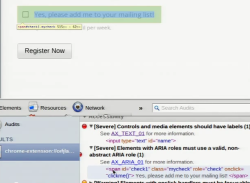
Screenshot of accessibility check
Checking accessibility with Chrome
At its Google I/O developer conference, Google has presented new tools and improved versions of existing tools aimed at helping to make web sites accessible for people with disabilities. According to Rachel Shearer, a software engineer at Google, there are more partially sighted people in the US than there are internet users in Canada.

“Many web apps are not fundamentally inaccessible in design,” added Shearer, “but simple errors can cause big problems for users.” One example is failure to assign labels to entry fields in forms. Existing test tools all have major disadvantages, and Google therefore decided to take the matter in hand by putting together a set of Accessibility Developer Tools for its Chrome browser. This extension is available under an open source licence and was unveiled at Google I/O in San Francisco. It requires Chrome 21.0.137.1 or later, and experimental extensions need to be enabled in settings.

ChromeVox is an open source screen reader realised as a Chrome extension. It uses Chrome’s text-to-speech (TTS) engine, which synchronises sound output with whatever is happening onscreen. As well as using the TTS engine API, programmers can also access locally installed language libraries or send requests to a server which returns an audio stream. ChromeVox is very thorough and precise.

However, there is also a need to avoid irritating regular visitors who use speech output. Regular users of a web site will already be familiar with any static elements. Having every option read out every time a site is visited is a great way of losing customers. The ChromeVox API therefore allows content to be tagged to indicate how important it is for screen readers. End users can then determine the level of detail for output using shortcut keys.

One case where ChromeVox has been used successfully is in a terminal emulation with SSH client written by Google developer Dominic Mazzoni one weekend. His Secure Shell (beta) runs in Chrome and provides the user with audio feedback.

Mazzoni also noted, however, that tools for accessible web sites already exist. Chrome has supported CSS3 filter effects since version 19. A single line of code enables users to view the entire page with colours inverted. This often enhances contrast and makes viewing easier for visually impaired users. Specific content, such as jpg files, can be excluded using code.

Daltonize!, a Chrome extension for colour-blind users which was also written by Mazzoni, has been around for a while. Colour blind users can modify the way sites are displayed, and developers can simulate the effects of colour blindness. A bookmarklet for other browsers is also available. Mazzoni anticipates this task soon being taken care of by the WebGL pixel shader for Webkit that is currently under development.

For the more experimental, there is also the Chrome Speech Recognition Extension API. Voice input yields a range of detection variants ordered in terms of hit likelihood as determined by the algorithm. Web applications can then select from this list.


via http://www.speechtechnologygroup.com/speech-blog - Now text to speech and speech recognition capabilities are built directly into the chrome browser..... Checking accessibility with Chrome At its Google I/O developer conference, Google has presented new tools and improved versions of existing tools aimed at helping to make web sites accessible for p ...

40+ Voice Searches Demonstrated On Jelly Bean (video) » Geeky ...

Jellybeans new speech recognition capabilities versus Siri......

An impressive demo has been put together showing the new voice recognition and Voice Search feature included within Google's latest Android 4.1 Jelly Bean operating system.: http://www.google.com/url?sa=X&q=http://www.geeky-gadgets.com/40-voice-searches-demonstrated-on-jelly-bean-video-03-07-2012/&ct=ga&cad=CAcQARgBIAIoATAAOABAkaTM_wRIAlgAYgVlbi1VUw&cd=SOoDOf7MLTE&usg=AFQjCNF53tqFYUfv0fqCMuMAgNNZ9vznRA
via http://www.speechtechnologygroup.com/speech-blog - Jellybeans new speech recognition capabilities versus Siri...... An impressive demo has been put together showing the new voice recognition and Voice Search feature included within Google's latest Android 4.1 Jelly Bean operating system. : http://www.google.com/url?sa=X&q=http://www.geeky-gadgets.co ...

M*Modal Acquired for $1.1 Billion

The competition in the speech recognition market for the medical industry is heating up......,,

M*Modal, a clinical documentation services and speech recognition solutions provider, has been acquired by One Equity Partners, the private investment arm of JP Morgan Chase & Co., for approximately $1.1 billion. The deal is expected to close during the third quarter of 2012.

“M*Modal presents a unique opportunity to acquire a market leader in clinical documentation at a time when the company has successfully released its new generation of speech understanding solutions for healthcare,” said Dick Cashin, managing partner of One Equity Partners, in a statement. “We will support M*Modal’s outstanding management team to invest in and build on M*Modal’s reputation for technical innovation and quality products and services as the company ramps up its delivery of powerful new solutions to enhance the processing and understanding of healthcare information.”

Under the terms of the agreement, M*Modal shareholders will receive 14 dollars in cash for each outstanding share of M*Modal common stock they own, representing an 8.3 percent premium over the closing price on July 2, 2012, the last full trading day before today’s announcement. This price represents a 19.3 percent premium over the 180-day volume weighted average closing price of M*Modal common stock ending on such date and a 33.8 percent premium over the 52-week volume weighted average closing price of M*Modal common stock ending on such date.

“M*Modal continues to reach major milestones in technological innovation, product leadership, and customer successes,” said Vern Davenport, chairman and CEO of M*Modal, in statement. “One Equity Partners matches our passion and drive, and we believe [it] will be the right financial partner to accelerate our strategic goals and further enhance our leadership position as the entire industry focuses on improving the cost and quality of care. Our focus is and will continue to be on serving customers through our clinical documentation services and Speech Understanding solutions that unlock value from the unstructured clinical narrative.”

M*Modal has launched several new products this year, including Catalyst Suite, which provides infrastructure for large-scale deployment of NLU applications, and M*Modal Fluency, a line of clinical solutions built on the company’s cloud-based healthcare Speech Understanding platform. The company also introduced M*Modal Fluency Direct, which speech-enables EHRs and other clinical systems on workstations in the enterprise.

via http://www.speechtechnologygroup.com/speech-blog - The competition in the speech recognition market for the medical industry is heating up......,, M*Modal, a clinical documentation services and speech recognition solutions provider, has been acquired by One Equity Partners, the private investment arm of JP Morgan Chase & Co., for approximately $1.1 ...

Sunday, July 1, 2012

Microsoft Partners With Audible For Better Speech Recognition, Available Today For WP7.5

Microsoft's powerful speech recognition engine starts becoming more visible for the mobile space

IMG_0611

In a canned video demo, Microsoft gave an update to its speech recognition software that allows users to have a conversation with apps. Sounds like Siri, right? To be fair, Windows Phone has had speech recognition capabilities since launch.

But today, Microsoft announced a partnership with Audible for improved speech recognition. In the video demo a woman jumps into her car and launches turn-by-turn directions from an address that was texted to her. Maps quickly notified the driver that the normal route is backed up by an accident and asked whether she wanted to take a different route. Driver acknowledged the new route but the software took it a step further and asked whether her date should be notified via text that she may be late.

Audible will be available later today for 7.5 devices. The tools necessary for developers to enable functionality like the one in the demo video will be released for Windows Phone 8 later this summer.

via http://www.speechtechnologygroup.com/speech-blog - Microsoft's powerful speech recognition engine starts becoming more visible for the mobile space In a canned video demo, Microsoft gave an update to its speech recognition software that allows users to have a conversation with apps. Sounds like Siri, right? To be fair, Windows Phone has had speech r ...